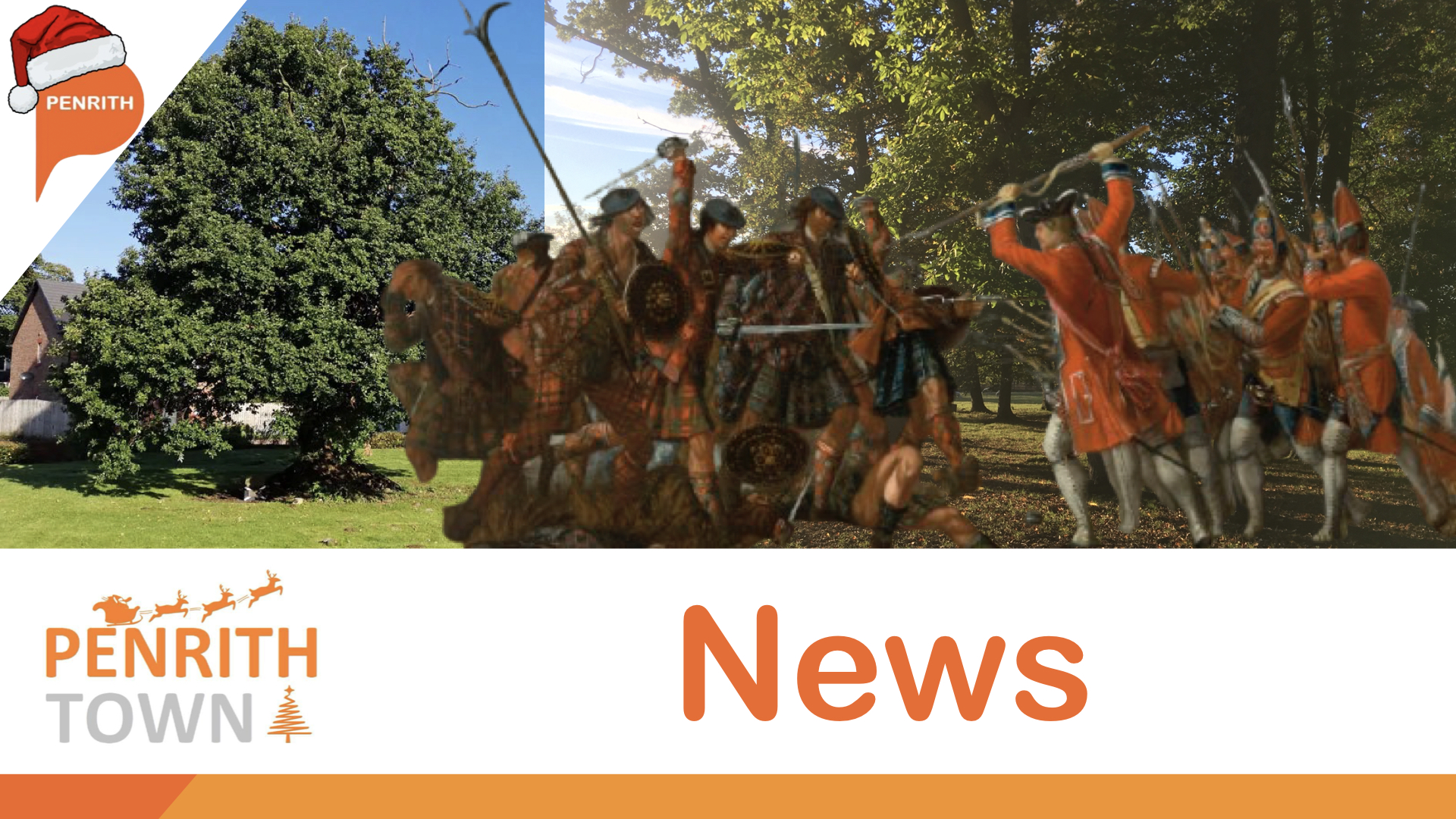
A battlefield with Government forces engaging in a battle with an invading army is a headline all to common in many parts of the world today, but not something many would consider a headline of events unfolding just a few miles South of Penrith.
Today, 18th December 2025, marks the 280th anniversary of such
a battle that took place just three miles south of Penrith along what is now
the A6 in the village of Clifton.
A battle considered to be the last battle fought on English
soil. A battle that not only played a role in shaped the county in 1745 but
that shaped the country we live in today and left lasting legacies locally in
Clifton and in Penrith.
On this day in 1745, as Bonnie Prince Charlie's Jacobite
forces retreated from Derby, After invading England in an attempt to reclaim
the throne lost by King James VII of Scotland and II of England in 1688. Bonnie
Prince Charlie's Jacobite forces engaged with government troops led by the Duke
of Cumberland at Clifton. The battle resulted in the deaths of 12 Jacobite’s
and 10 government soldiers, etching Clifton's name into history as it became
the last battle on English soil.
Clifton retains many reminders of the historic event in
1745, A 400-year-old oak tree, now part of the Oaks housing estate, serves as a
Scottish war cemetery and stands as a living testament to the past. Protected
by a preservation order, the tree now marks the entrance to the housing estate
but is also the final resting place of some of the fallen Jacobite army that
battled in Clifton 280 years ago today.
In St. Cuthbert's Churchyard in the village, a gravestone
commemorates the English soldiers who also perished in the 1745 battle, while a
memorial built around the village well further honours Clifton's significant
place in history and the last battle on English soil. Local street names also
provide a modern reminder to the history that unfolded in Clifton on the 18th
of December 1745.
The Duke of Cumberland also spent the night after the
fighting in Clifton with Town End Cottage hosting the Duke overnight and local
street names such as Cumberland Close and Cumberland Way in the village today mark
the links with the communities place in history.
The 1745 society marked the 80th Anniversary today with the
laying of wreaths at the English headstone of Blands regiment and at the oak
tree of the Jacobite highlanders.
Unfortunately, a planned part of the days event with Clifton
school had to be cancelled due to an outbreak of chickenpox but it’s hoped this
part of the anniversary events will take place in June.
Clifton Community Council have also resolved to commission
an art instillation as part of a lasting memorial to the last battle and to
mark the occasion of the 280th anniversary working with local artists. Work is
also underway to renovate the Clifton Kelter Well that had a memorial created
around it to celebrate the 250th anniversary.
The Chair of Clifton Community Council speaking on the 280th
Anniversary of the Last Battle on English Soil said:
“Today in Clifton we mark the 280th anniversary of the
Battle of Clifton — a small engagement by the scale of history, yet one of
immense significance. It was here, on these fields and lanes, that the last
battle fought on English soil took place. Ordinary ground became, for a brief
and violent moment, a place of fear, confusion, courage, and loss.”
“The men who fought here in 1745 were not legends carved in
stone. They were sons, fathers, neighbours — many far from home — swept into a
battle larger than themselves. Some never returned. Others carried the memory
of this place for the rest of their lives. Today, we remember them not to
glorify war, but to acknowledge its cost.”
“Clifton stands as a reminder that wars and battles are
never abstract. It does not exist only in history books or distant lands. It
arrives at doorsteps. It crosses fields. It interrupts lives.”
“And that reminder feels especially important today.”
“As we stand here in the twenty-first century, the world
once again feels unsteady. Conflict spreads. Tensions harden. Language becomes
sharper. Lines are drawn, and compromise is too often dismissed as weakness. We
hear talk of escalation, of inevitability, of preparing for the worst — as
though humanity has no other choice.”
“But history tells us otherwise.”
“The lesson of places like Clifton is not that war is
unavoidable. It is that war is a failure — of understanding, of restraint, and
of imagination. Every conflict begins with leaders who believe that force will
succeed where dialogue has failed. And every conflict ends with the realisation
that the cost was greater than anyone admitted at the start.”
“Those who fought here 280 years ago could not know how
history would judge them. But we can decide how history will judge us.”
“Will future generations look back on this period and see
leaders who stumbled into catastrophe despite every warning? Or will they see a
moment when humanity paused, reflected, and chose a different path?”
“Choosing peace does not mean ignoring injustice. It does
not mean weakness. It means recognising that violence multiplies suffering and
narrows the future for everyone. It means understanding that restraint,
cooperation, and empathy are not naïve ideals, but hard-won necessities.”
“From this quiet village that once knew the sounds of
gunfire fire and marching boots, let us send a simple message: we remember. We
remember the past not to repeat it, but to learn from it.”
“May those with power today have the courage to step back
from the brink. May they listen not only to generals and strategists, but to
history itself — and to the ordinary people who always pay the highest price
when war is chosen.”
“And may Clifton, remembered for the last battle on English
soil, also stand as a symbol of something better: a hope that humanity can
finally learn enough from it’s past to protect its future so that Clifton will
forever be the site of the last battle on English soil in 1745.”



 Then select "Add to Home Screen"